

The Rising Complexity of HCC Medical Coding :
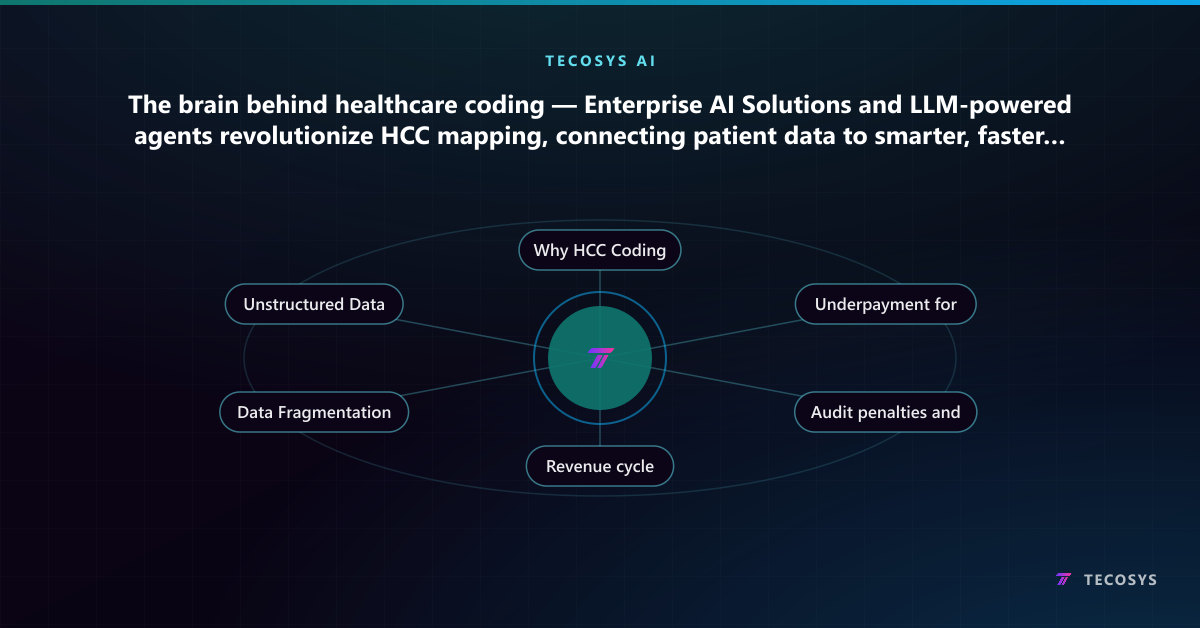
- Why HCC Coding Matters in Risk Adjustment?
The CMS-HCC model underpins risk-adjusted reimbursement in Medicare Advantage and certain ACA plans. It assigns risk scores based on documented chronic conditions, directly affecting how much a healthcare provider or insurer is reimbursed.
Errors in HCC medical coding — whether through missed codes, incorrect mappings, or outdated code sets — can lead to:
- Underpayment for high-risk patients
- Audit penalties and compliance risks
- Revenue cycle inefficiencies
2. Challenges Facing Traditional HCC Coders
While remote HCC coding jobs have opened global opportunities for medical coders, challenges persist:
- Data Fragmentation — Patient records often span multiple EMRs and imaging systems.
- Unstructured Data Overload — Clinical notes, discharge summaries, and lab reports remain in free text.
- Human Error and Fatigue — Manual review is time-consuming and prone to oversight.
- Evolving Regulatory Requirements — Annual CMS-HCC updates require constant retraining.
In this environment, scaling accurate HCC coding is a monumental task without automation.
Tecosys AI — Enterprise AI Solutions for HCC Mapping :
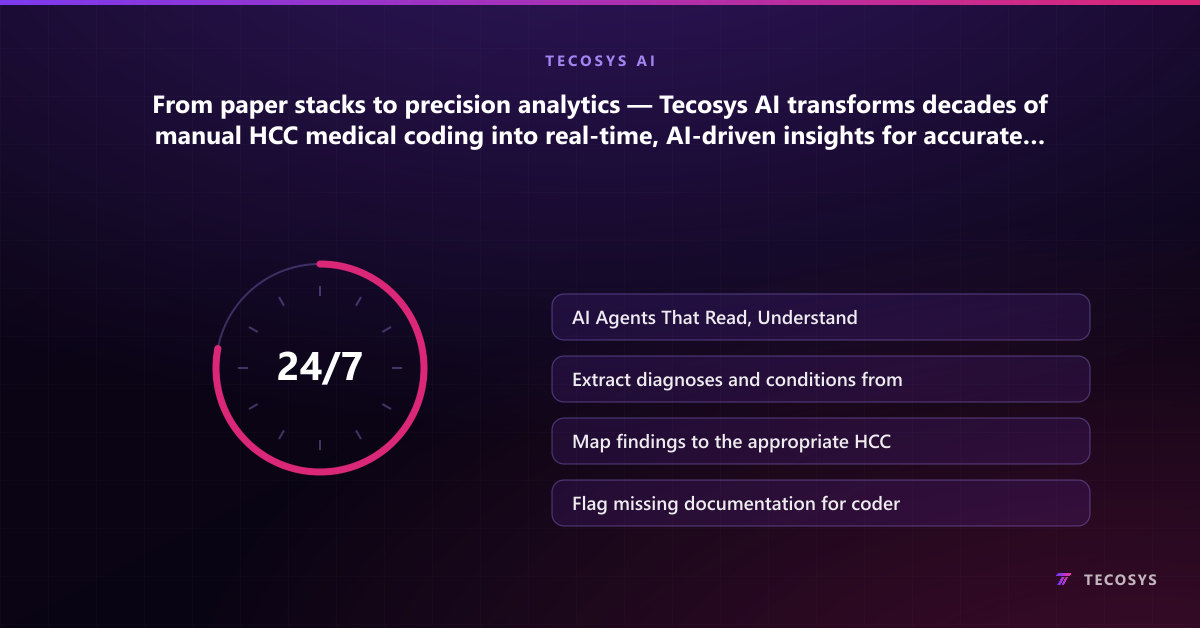
- AI Agents That Read, Understand, and Code
Tecosys AI deploys specialized AI Agents trained on vast healthcare datasets, clinical terminologies, and Enterprise LLMs fine-tuned for healthcare coding tasks. These agents can:
- Extract diagnoses and conditions from unstructured text
- Map findings to the appropriate HCC codes in compliance with CMS guidelines
- Flag missing documentation for coder review.
By integrating Enterprise AI into the coding pipeline, Tecosys ensures speed, accuracy, and audit readiness.
2. Enterprise LLMs for Context-Aware Coding
Unlike generic AI models, Tecosys’s Enterprise LLM is tailored to healthcare coding:
- Contextual Understanding — Interprets clinical nuances like “history of” vs “current diagnosis.”
- Terminology Mastery — Aligns with ICD-10-CM, CPT, and CMS-HCC updates.
- Risk Adjustment Alignment — Directly maps findings to the correct risk categories.
This ensures that the AI-powered HCC mapping process is not only fast but clinically sound and compliant.
How AI-Powered HCC Mapping Works :
1. From Charts to Codes — The Workflow
- Data Ingestion — The AI ingests structured and unstructured patient data from EMRs, EHRs, and scanned charts.
- Entity Recognition — Using NLP, it identifies relevant medical conditions and diagnoses.
- Code Mapping — Conditions are mapped to the appropriate HCC categories and ICD-10 codes.
- Risk Score Calculation — AI calculates preliminary risk scores for review.
- Human-in-the-Loop Validation — Coders review flagged cases, ensuring accuracy before submission.
2. Case Example
A health plan with 100,000 Medicare Advantage members integrated Tecosys AI into its coding workflow. Within 3 months:
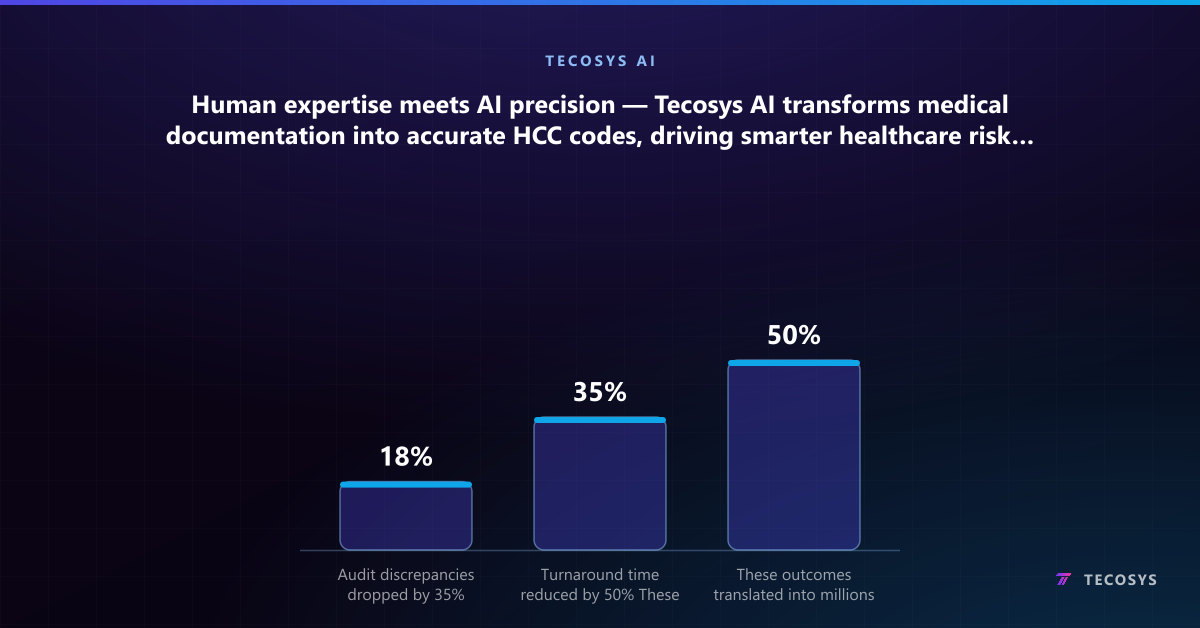
- Coding accuracy improved by 18%
- Audit discrepancies dropped by 35%
- Turnaround time reduced by 50%
These outcomes translated into millions in recovered revenue and significantly reduced compliance risk.
Benefits of AI-Powered HCC Mapping with Tecosys:
1. Accuracy and Compliance
By leveraging Enterprise AI Solutions, Tecosys ensures coding accuracy meets or exceeds auditor standards, reducing exposure to financial penalties.
2. Scalability for Remote Coders
For teams managing remote HCC coding jobs, Tecosys enables centralized, cloud-based workflows where coders anywhere in the world can work with AI-assisted suggestions.
3. Reduced Training Burden
With AI Agents constantly updated with the latest CMS HCC rules, coders spend less time retraining and more time validating high-value cases.
4. Cost Efficiency
Automation reduces the manual workload by 40–60%, freeing coders to focus on complex cases while cutting operational costs.
The Future — AI in Risk Adjustment Beyond 2025
AI’s role in HCC risk adjustment will evolve to include:
- Predictive Risk Forecasting — Anticipating chronic disease progression
- Real-Time EMR Integration — Live code suggestions at point of care
- Automated Audit Trail Generation — Instant documentation for compliance
With Enterprise AI capabilities, Tecosys is poised to lead this transformation, making HCC coding faster, smarter, and more reliable.
Frequently Asked Questions
How does
Tecosys AI leverages AI Agents powered by Enterprise LLMs to process medical charts, identify diagnoses, and match them to the correct HCC codes. This reduces manual errors, accelerates turnaround times, and ensures compliance with CMS guidelines for HCC risk adjustment.