AI-Enhanced Telehealth Platforms: Building the Virtual Hospital of 2025
Virtual hospitals and telehealth have become the modern pillars of healthcare transformation, connecting patients and providers through seamless technology that enables instant care, continuous monitoring, and real-time remote alerts—reshaping how care is delivered beyond traditional walls. The healthcare industry now faces a decision about how fast telehealth technology will change medical practices instead of debating its potential arrival. The article examines how AI-based telehealth systems together with remote patient tracking and virtual medical consultations and cloud-based healthcare systems will create the "hospital of 2025." The article demonstrates patient-focused trustworthy healthcare delivery methods through practical system designs and deployment methods.
8 min readTecosys
Why the Virtual Hospital of 2025 Is Emerging Now?
1.1 Market Momentum & Opportunity
The market for “AI in telehealth & telemedicine” will expand from USD 5.3 billion in 2025 to USD 86.3 billion by 2034 at a 36% annual growth rate. The expanding market indicates healthcare delivery will transform through new delivery methods which create business prospects for healthcare providers and technology businesses.
1.2 Trends Driving Change
The development of virtual hospitals advances because of these fundamental market trends:
AI-based chatbots and virtual assistants and conversational agents now support patient triage and engagement through their integrated systems.
The healthcare industry now uses remote patient monitoring (RPM) and connected devices to track patients throughout their entire treatment process.
The healthcare organizations use cloud-based telehealth systems to create virtual care platforms which enable seamless connections between patients and their care teams.
The healthcare industry now accepts hybrid care delivery which combines physical visits with virtual consultations while patients expect basic digital health services including telehealth urgent care and online doctor visits.
1.3 Keywords & Search Intent in 2025
Healthcare SEO research shows that patients search for specific terms including “online doctor near me” and “virtual urgent care” and “telehealth services + [city/state]” and “remote patient monitoring platform”.
TecosysAI achieves better search visibility through content optimization that matches patient search patterns.
Defining a Virtual Hospital: What It Looks Like in Practice
2.1 The Digital Front Door
The digital front door serves as the foundation of a virtual hospital because it enables patients to schedule appointments and start video calls and share wearable data and interact with virtual assistants and access their medical information and care team details.
2.2 Core Components
The following elements form the foundation of this system:
The system uses natural language processing (NLP) and conversational agents to perform virtual triage and scheduling and history collection and clinician escalation.
The system uses remote patient monitoring (RPM) and wearable integration to track patient vital signs which then get analyzed through predictive algorithms.
The virtual care system enables patients to access primary care services and specialty consultations and urgent care services and follow-up appointments through video conferencing.
The system uses data analytics and predictive algorithms and AI insight engine to detect potential health risks including patient deterioration and readmission threats and chronic disease management needs.
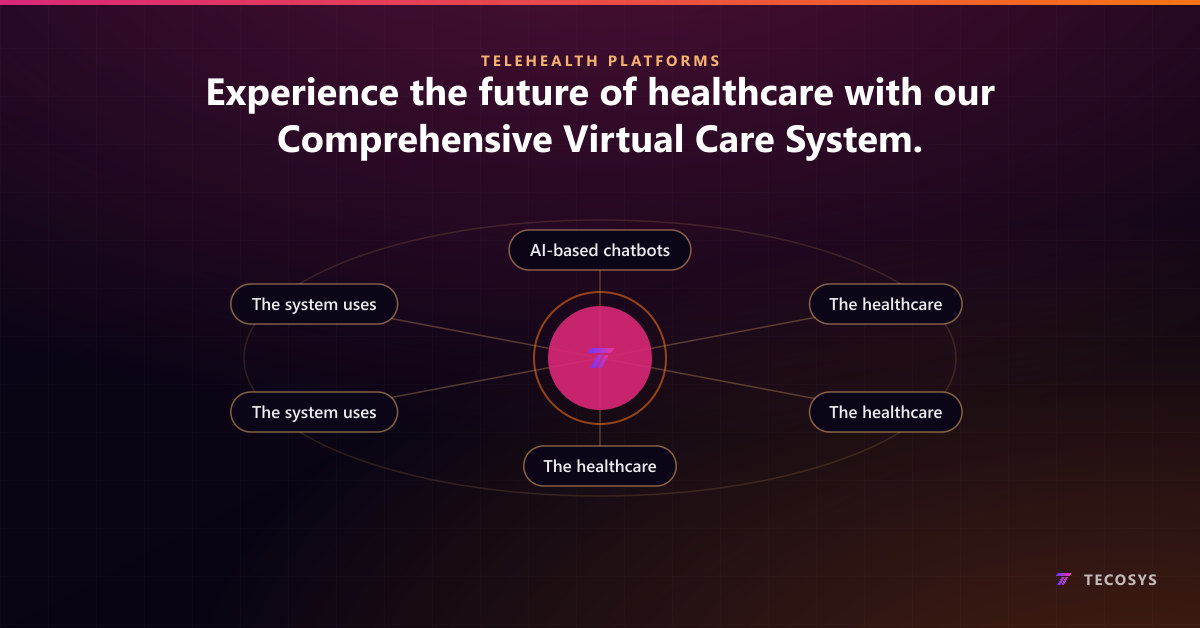
Experience the future of healthcare with our Comprehensive Virtual Care System.
The system requires cloud-based infrastructure with secure data management and interoperability features to achieve scalability and reliability and maintain compliance standards.
2.3 Case Examples
A patient with chronic heart failure getting discharged from the hospital receives a wearable that monitors weight, BP, and activity. If data triggers an alert in the virtual hospital platform, make way for a video visit with a cardiologist before things go out of hand.
The mother schedules an online pediatric consultation on her mobile phone, uploads photos of her child’s rash and chats with the AI-assistant for triage before connecting with the paediatrician — all in one flow.
How TecosysAI Builds the Virtual Hospital Platform
3.1 Expertise Overview
TecosysAI utilizes its profound knowledge in automating clinical documentation, artificial intelligence-powered care workflows, and telehealth infrastructure to create platforms that enable care teams and improve patient experience. It collaborates with health systems to lessen clinician load increase virtual-care accessibility and produce practical insights from actual data.
3.2 Platform Features & Architecture
This is how we superimpose the virtual hospital of 2025 right here and now:
Automatic clinical documentation- Our AI listens in. and summarizes the virtual visit in real-time so that clinicians can actually see patients rather than doing paperwork about seeing patients.
Conversational triage bot- Patients talk normal English to our bot which figures out urgency takes history and schedules followup.
Integrated RPM dashboard- Clinicians and care teams get one view of remote-monitoring data, alerts, and trends.
Predictive analytics core: Powered by machine-learning, risk of readmission to the hospital, and current state or need for intervention is determined.
Scalable cloud deployment & interoperability: We make sure it works with major EHRs as well as security & compliance (HIPAA, SOC2) and actual multi-site scaling support.
3.3Real-World Impact
With this platform, health systems are able to decrease their virtual visit no-show rates due to easier scheduling and reminders.
Building Trust: E-E-A-T & Other Considerations
4.1 Experience & Expertise
This team fuses the knowledge of clinicians, health-IT architects, and AI technologists with long years of experience in telehealth, digital health platforms, and machine-learning in healthcare. We have a solid background in care pathways operationalization, device integration, and virtual-care programs scaling.
4.2 Authoritativeness
We base our platform design on current industry research: for example, the 2025 Watch List for AI in healthcare emphasises “AI for notetaking”, “AI for disease-detection and diagnosis”, and “AI for remote monitoring”. NCBI These are the priorities we pursue.
4.3 Trustworthy
Virtual care requires trust. Key safeguards include: Transparent policies related to data usage, algorithmic bias and accountability. NCBI Security and privacy compliance, strong encryption, audit trails. Effective communication with patients about how AI is used in their care is important.
4.4 SEO & Content Trust Signals For SEO, we make sure our blog and platform content:
Uses reliable sources and credits them.
Has actual clinical or use-case examples to show experience.
Is easy to read and focused on the patient.
It doesn't overshares; as they are already very revised with their rules and scope.
Looking at telehealth keyword searches in 2025, content needs to match what patients really want (like see a doctor online today or prescription refills online).How to Get Started: From Plan to Launch
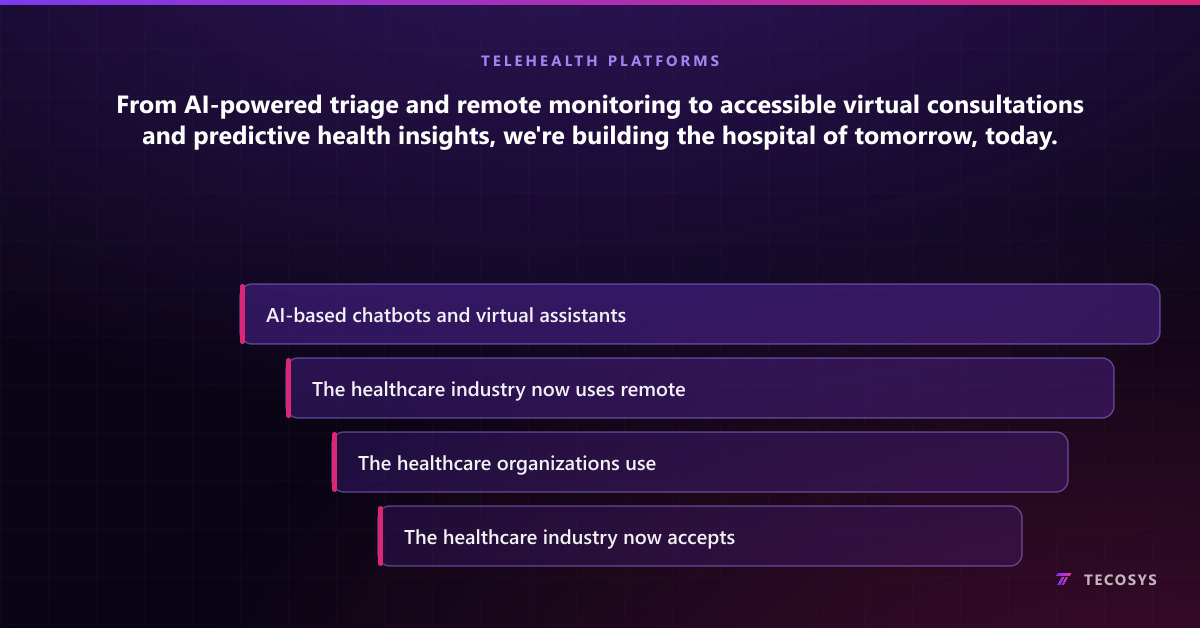
From AI-powered triage and remote monitoring to accessible virtual consultations and predictive health insights, we're building the hospital of tomorrow, today.
How to Get Started: From Plan to Launch
Phase 1: Planning
1. Pick the patients you want to reach (for example, those needing long-term care, quick care, or check-ups). 2. Figure out how the virtual hospital will work (from initial contact to check-ups). 3. Choose the right tech partners (for things like speech recognition, data processing,
device links, and cloud services).
Phase 2: Building
1. Get the virtual assistant ready. 2. Link up remote monitoring devices and sensors. 3. Set up doctor scheduling, video appointments, and automated paperwork. 4. Create data systems and dashboards.
Phase 3: Testing and Growth
1. Test with a small group of patients and track things like satisfaction, doctor workload, no-show rates, and how well patients stick to remote monitoring. 2. Fix any issues with rules, privacy, data fairness, and how well workflows are being used. 3. Grow to more departments and locations and make changes based on data and feedback.
Phase 4: Keeping Up
1. Watch for telehealth trends (like AI for paperwork or mixed care models). 2. Update content, patient plans, device integrations, and AI. 3. Offer more virtual hospital services, like specialist care or drug advice.
Issues and Answers
6.1 Norms and Remissions
Telehealth rules and payments differ from place to place. Doctors need to know about licensing, treating patients across state lines, and insurance rules.
Tip: Create your plans to allow for changing rules, roll things out a bit at a time, and keep track of payment results.
6.2 Data Quality, Privacy, and Fairness AI needs good, fair data to work. If the data or AI isn't fair, it can hurt trust and results.
Tip: Test for unfairness, get different kinds of patients involved, and keep checking your AI.
6.3 Doctor Acceptance and Work Changes
Doctors don't want to use technology alone. The tasks of virtual hospitals should be smoothly integrated into their day.
Tip: Involve the doctors early, train them well, and make their lives easier-automate wherever possible.
6.4 Patient Experience and Access
Not all patients can use virtual care as easily, and it needs to be available to all.
Tip: Offer choices, make it user friendly, and most importantly, help a patient to get comfortable using technology.
Why TecosysAI is Your Partner for the Virtual Hospital of 2025
At TecosysAI, we are uniquely positioned to help health systems, telehealth providers, and digital-health companies build and scale the virtual hospital model. Our strengths include:
Clinical documentation automation: Reducing clinician overhead, improving accuracy and freeing time for care.
AI-powered telehealth workflows combine virtual triage, remote monitoring, and analytics on a single, coherent platform.
Evidence-based design that aligns with market growth data, industry best practices, and research on AI in healthcare.
We invite you to partner with us, so you can focus on delivering meaningful care while we power the virtual hospital architecture behind the scenes.
The future of care is virtual, but the virtual hospital in 2025 isn't about video visits; it's about AI-enhanced telehealth platforms, seamless patient experiences, continuous remote monitoring, predictive analytics, and a trusted digital front door. For organisations ready to transform, the time is now. With TecosysAI as your partner, you can build a care delivery model that meets patients where they are, scales across populations, and delivers better outcomes.
Let's build the hospital of tomorrow—today.
If you're ready to explore how an AI-enabled virtual hospital platform can transform your care delivery, contact TecosysAI to set up a demo and roadmap discussion. How does TecosysAI support the Virtual Hospital of 2025?
TecosysAI provides an end-to-end AI-driven telehealth platform that automates note-taking, triage, and documentation in real time.
It integrates with leading EHR systems and remote patient monitoring devices, ensuring a seamless digital-care experience that is secure, compliant, and scalable.
Frequently Asked Questions
Is an AI telehealth platform HIPAA-compliant and secure?
Yes, leading platforms, such as TecosysAI, follow strict compliance frameworks like HIPAA, SOC 2, and GDPR. Data are encrypted in transit and at rest, with secure authentication, audit trails, and privacy controls that maintain patient trust and ensure compliance with regulatory requirements.
Can AI replace human doctors in virtual hospitals?
No, AI doesn't replace clinicians; it augments them. These AI tools automate routine administrative tasks, provide clinical insights, and allow doctors to focus more on patient care.
What technologies power a virtual hospital?
Core technologies include:
How can patients access virtual hospital services?
Patients can connect via the mobile app or through a web portal, where they can:
What are the main challenges in the implementation of telehealth platforms?