The Future of Workflows: How Nutaan AI Simplifies Complex Decisions
Work tasks are becoming more complicated and businesses in the modern high-paced digital world are swarmed with these problems. Each of the decision, be it in the finance or healthcare sectors, supply chain or customer contact, there is a huge volume of data to be fed in, compliance issues and cross functional dependencies have to be brought into the picture. The risk of a bottleneck based on conventional system and manual decision-making process can prove to be inefficient, produce miscommunication, and loss of opportunity.
It is here that Nutaan AI comes in. Applying Enterprise AI Solutions, AI Agents and Enterprise LLM (Large Language Models) to workflow ecosystems, Nutaan AI can turn the decision-making process into proactive decision intelligence, rather than reactive guesswork.
The future of work is easier without compromise- Streamlining processes to become smarter, quicker and more responsive. This blog discusses the way that Nutaan AI is leading this transformation, making complex decisions simple, and defining how intelligent enterprises will work in the future.
6 min readTecosys
1. The History of Enterprise Workflow Development may be classified into three steps
a. Manual & Rule-Based Systems
Manual rulebooks and spreadsheets, human intuition are static and organizations relied on this. Although these systems worked well in structured and predictable settings, they were ill prepared to deal with scale and complexity.
b. Auto & Digitalization
Enterprises began using repetitive tasks in the form of ERP, CRM, and RPA tools. However, as automation enhanced effectiveness, it did not help to enhance the decision intelligence. Complex situations did not allow to work without manual operations, and data existed in different silos, which delayed the delivery of findings.
c. Intelligent Workflows AI-powered
Businesses nowadays are facing the dawn of a new era where AI Agents and Enterprise AI platforms drive the workflows. Such systems not only automate the tasks, but also interpret information, learn patterns and suggest or even do the best action in real time.
This paradigm shift means the future is obvious: processes will no longer exist as inflexible, fixed, linear workflows: they will be as flexible and self optimizing AI-enabled ecosystems.
2. Causes Bottleneck in Complex Decision-Making decisions is the greatest challenge in all businesses
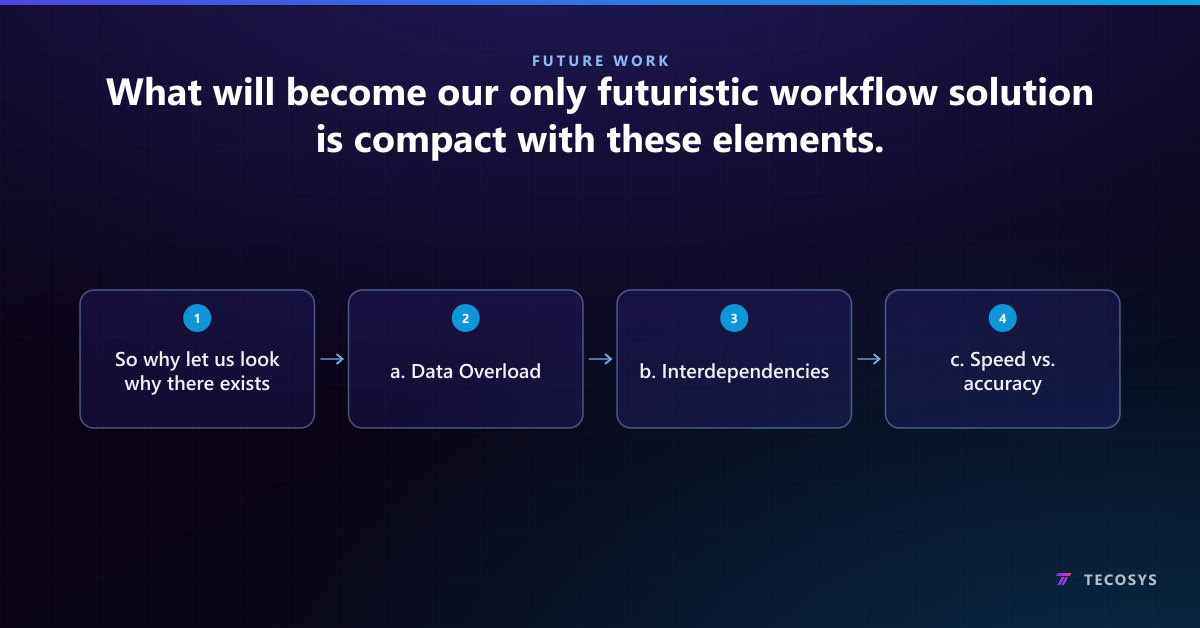
So why let us look why there exists a stiff competition in highly intellectual decision-making processes in enterprises :
a. Data Overload
Organizations create structured and unstructured data in petabytes in the course of a day. The leaders cannot do the analysis without the proper tools, which cause the analysis paralysis.
b. Interdependencies
Before a decision is made in one department, it usually affects the other departments and therefore, coordination and integration becomes necessary.
c. Speed vs. accuracy
Delaying action due to a protracted analysis is on one hand risky, but hastening decisions without any insights poses risk as well.
d. Dynamic market conditions
What is working today, may not work tomorrow. Volatile environments cannot be adapted to using static systems. This is the reason why automation is not enough: businesses should have intelligence already inbuilt in the workflows.
What will become our only futuristic workflow solution is compact with these elements.3. Nutaan AI: Challenging What is Next in Workflows
Nutaan AI is at the cross-section of Enterprise AI Solutions and decision intelligence platforms. It is straightforward in its mission: streamline complicated choices with AI being directly plugged into core workflows.
a. Decision Support AI Agents
Nutaan AI uses AI Agents (highly specialized, self-governing agents developed to investigate data, identify anomalies, and prescribe the superior course of action). These agents dynamically learn, instead of being able to make static systems, thus making better decisions as time goes on.
Case Study : In healthcare finance, AI Agents have the potential to streamline healthcare financing through billing systems by helping to identify coding errors, suggest risk adjustments and help ensure compliance with various regulations.
b. Knowledge-Driven Insights Enterprise LLM
Nutaan AI has Large Language Models (LLMs) that can enable enterprises to have natural language understanding enhanced. They turn unstructured documents, compliance texts and communication data into actionable insight.
Use case : An investment team could use the LLM to immediately summarize a spreadsheet portfolio-level risk exposure data, regulatory changes or other customer communications-saving hours of manual input.
c. Orchestration of End-to-End workflow
Nutaan AI does not only focus on insights- it harmonizes operations between departments. It can be combined with other current tools (ERP, CRM, RPA) to make up the smooth decision pipeline.
Example : Nutaan AI can relate demand forecasts, logistics data, and supplier performance in supply chain management so that the procurement schedules are automatically altered.
d. Real-Time Adaptability
The site is fueled by instant publishing. A regulatory change, market shift, customer sentiment, Nutaan AI balances workflows in real-time to make decisions based on the most up to date context.
4. Enterprise workflow advantages of Nutaan AI
a. Supersized efficiency going beyond automation
Robots reduce expenses, however, AI-powered processes provide efficiency on a large scale by eliminating decision making points. Nutaan AI means decisions are more time efficient and more accurate.
b. Smart Data Driven Decisions
Nutaan Artificial intelligence provides leaders across healthcare, finance, and enterprise operations with big data analytics that enable them to take action based on insights, rather than assumptions.
c. Risk Mitigation & Cost Optimization
In full-scale coverage of healthcare coding via enterprise billing, Nutaan ai mitigates human error, creates compliance and maintains cost reduction by avoiding pit-falls.
d. Increased Transparency & Cooperation
Decision intelligence can be centralized by Nutaan AI, thus achieving transparency in processes. The same data-driven insights can be shared among different departments thereby minimizing silos.
e. On-the-go Learning & Change Nutaan AI
Unlike static ones, learns with each choice and becomes more exact and adaptable with time.
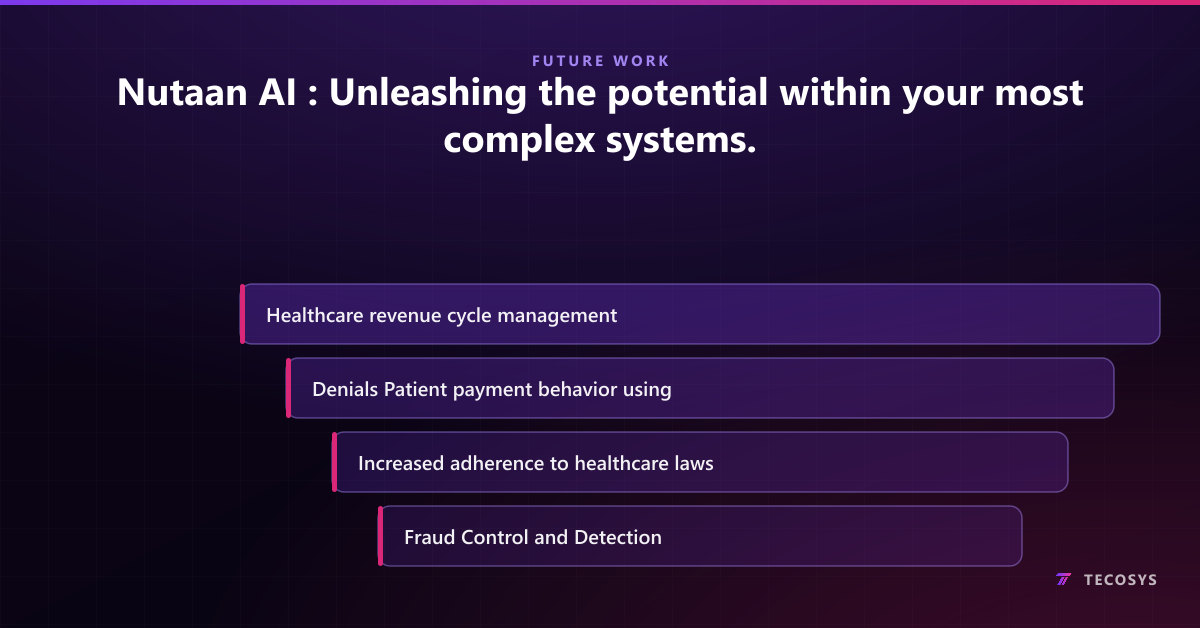
Nutaan AI : Unleashing the potential within your most complex systems.5. Industries Use Cases
a. Healthcare Finance
Healthcare revenue cycle management using AI Automated processing of claims.
Denials Patient payment behavior using predictive analytics.
Increased adherence to healthcare laws.
b. Financial Services
Fraud Control and Detection.
Modelling of risk and optimization of investment.
Portfolio management based on Artificial intelligence.
Individualization of customer experience.
c. Supply chain & Logistics
Real -time demand predictions.
Intelligent stock control.
Logistics route optimization.
Supplier risk analysis and response.
d. Enterprise Operations
Automated reporting and creation of insights.
HR Recruitment and workforce AI-based planning.
Customer-support AI agents
Intelligent Infrastructure monitoring.
6. The Competitive Advantage: Nutaan AI over traditional systems
Conventional enterprise applications are reactive i.e., they do tasks after they have been made to know what to do. In comparison, Nutaan AI is predictive and dynamic.
Traditional Automation: Type of automation which works according to rules pre-defined.
Nutaan AI: Trains over time, adjusts itself, simplifies complex decision making in real time.
Such a competitive advantage not only places enterprises in the position to follow market changes but also make them.
7. What does the Future of Intelligent Workflows entail ?
In the future, however, smart work flows will not only make decisions easier — they will pre-empt them.
Nutaan AI is leading this change by:
Enterprise LLMs are embedded to context surprise.
Implementing AI Agents within cross business unit.
Collaboration Basing predictive and prescriptive analytics on each point.
Turning workflows to self-healing and self-optimizing.
The vision: Businesses in which decision-making is no longer having been a burden, but a smooth flow of the innovation process.
8. Frequently Asked Questions :
1.In what ways is Nutaan AI different than the traditional workflow automation?
However, in contrast to conventional automation technologies, Nutaan AI does not simply automate the tasks; rather, it facilitates decision-making via AI Agents and Enterprise LLMs helping understand the data, make suggestions and change workflows in real-time.
2. Does Nutaan AI fit in an existing enterprise system ?
Yes. Nutaan AI combines with all the ERP, CRM, RPA, and billing solutions, to automate the process of orchestrating the workflow without destroying the prevalent infrastructure.
3. Which industries gain the most out of Nutaan AI ?
The main beneficiaries are healthcare, finance, supply chain and enterprise operations. Nonetheless, Nutaan AI can be used in any industry where there are data-intensive applications of decisions.
4. What does the Nutaan AI do to enhance healthcare finance processes ?
Nutaan AI optimizes revenue cycle management in healthcare to automate billing, minimize claim, improve regulatory knowledge and forecast patient payments.
5. Is Nutaan AI fit to the future?
Absolutely. Nutaan AI can adapt to market changes and enterprise requirements based on continuous learning, real time adaptability and Enterprise AI offered solutions.
The next enterprise workflows do not only concern automation but intelligent decision-making. Decisions that are complex refer to a bottleneck in the modern enterprises that slows down innovation and agility.
Nutaan AI closes this divide with a combination of AI Agents, Enterprise LLMs, and decision intelligence into workflow that are intelligent, expressive, and explainable.
To enterprises wishing to succeed in the coming decade, the message is clear, streamline decisions that would spur increased growth. And now the future of working is here with Nutaan AI.
Are you ready to reduce complexity in decisions and future proof your enterprise workflows?
Become a partner with Nutaan AI, and we will unlock the secrets of Enterprise AI Solutions. Allow Nutaan AI to make your workflows smarter (ecosystems). Make us contact you to have a demo and be the first to see the future of workflows in action!