
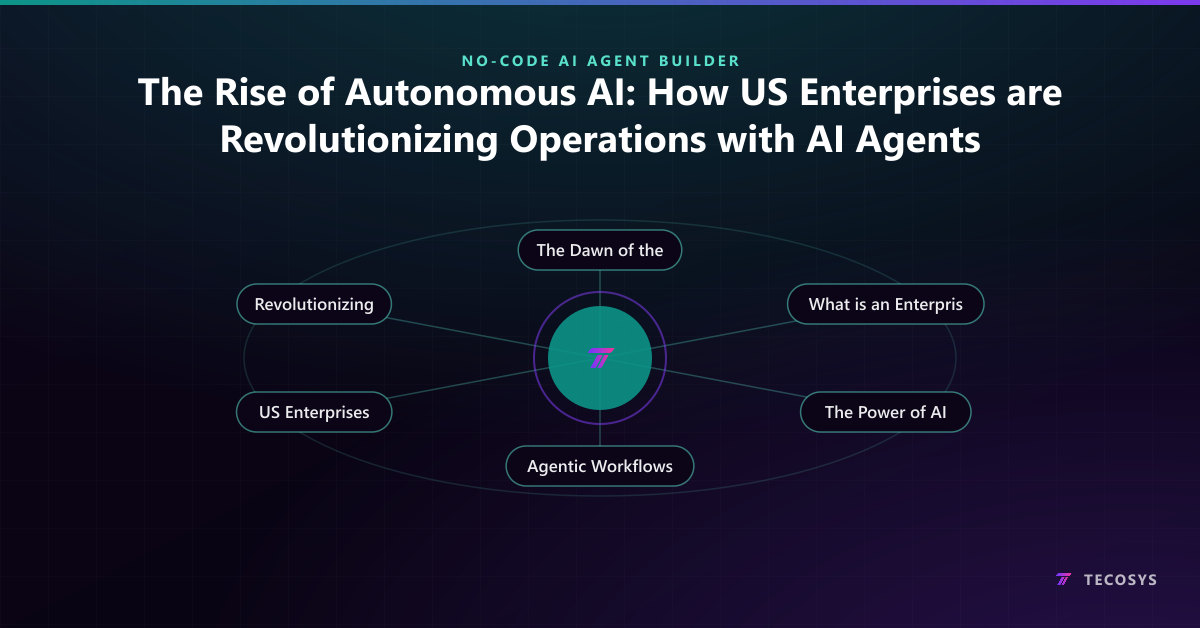
US enterprises are truly transforming their operations with the rise of autonomous AI agents. Imagine intelligent software that doesn’t just follow rules but learns, adapts, and makes decisions on its own. 1 These AI agents are the backbone of powerful AI workflow automation tools, revolutionizing everything from customer service, where AI agents for customer service provide instant, personalized support, to complex financial and supply chain operations. 2 Thanks to user-friendly no-code AI agent builders, even non-technical teams can harness this power. 3 It’s all about creating agentic workflows that boost efficiency, drive innovation, and ultimately, help businesses thrive by freeing up human talent for more strategic work.

Imagine a workday where routine tasks vanish into thin air, complex data translates into instant, actionable insights, and your best people are finally freed to focus purely on innovation and strategic growth. Sounds like a scene from a sci-fi blockbuster, right? Well, for a rapidly growing number of businesses right here in the United States, this isn’t a distant dream — it’s the daily reality powered by Enterprise AI Agents.
We’re standing at the precipice of a profound shift in how work gets done across corporate America. With expert estimates suggesting that up to 30% of current hours worked across the US economy could be automated by 2030, and a staggering 78% of US companies projected to be leveraging AI in at least one function by 2025, the core question for every leader is no longer if AI will transform your operations, but how quickly and effectively you embrace its most advanced forms.
This isn’t just about smarter software; it’s about a revolutionary new class of digital workforce — autonomous, intelligent agents capable of reasoning, planning, and executing complex tasks on your behalf. Join us as we explore how these cutting-edge Enterprise AI Agent solutions are not merely enhancing productivity, but fundamentally redefining the future of work for American businesses, driving unprecedented efficiency and competitive advantage.
The landscape of business operations in the United States is undergoing a profound transformation, spearheaded by the quiet yet powerful emergence of autonomous AI. Far beyond simple automation, the advent of AI agents is redefining efficiency, decision-making, and even the very structure of work within US enterprises. These intelligent entities, capable of perceiving their environment, making decisions, and taking actions with minimal human oversight, are no longer a futuristic concept but a present reality, reshaping industries from finance to healthcare, and manufacturing to customer service.
This comprehensive article will delve into the world of autonomous AI, exploring how US enterprises are adopting and deploying advanced enterprise AI agent platforms and sophisticated AI workflow automation tools. We will uncover the benefits, challenges, and transformative potential of these technologies, examining real-world applications and shedding light on the accessibility offered by no-code AI agent builders. By the end, you’ll have a clear understanding of what an agentic workflow truly entails and why AI agents for customer service are just the tip of the iceberg in this ongoing revolution.
For years, artificial intelligence has been a buzzword, often associated with sophisticated algorithms and data analysis. However, the current evolution points towards “agentic AI” — a paradigm shift where AI systems don’t just process information but act upon it, autonomously. An AI agent is essentially a software system designed to operate independently, interacting with its environment (digital or physical), making reasoned decisions, and executing tasks to achieve a specific goal.
Think of it this way: traditional automation might follow a pre-programmed script. If a condition isn’t met, it stops or flags an error. An AI agent, on the other to hand, possesses a degree of intelligence that allows it to adapt, learn from new information, and even self-correct. This adaptive capability is what makes them truly “autonomous” and differentiates them from earlier forms of automation.
An enterprise AI agent platform is a comprehensive software solution that enables organizations to design, deploy, manage, and scale AI agents across various business functions. These platforms are designed with the specific needs of large organizations in mind, focusing on security, scalability, integration with existing systems, and often, features that promote transparency and explainability in AI decision-making.
Key characteristics of a robust enterprise AI agent platform include:
These platforms move beyond simple Robotic Process Automation (RPA), which typically automates repetitive, rule-based tasks. AI agents introduce a layer of dynamic intelligence, allowing them to handle far more complex and evolving business processes, making them strategic assets for competitive US enterprises.
At the heart of autonomous AI’s impact lies AI workflow automation tools. These tools leverage AI to streamline, optimize, and automate entire business processes, often extending across multiple departments and systems. While traditional workflow automation follows predefined rules, AI-driven automation infuses intelligence, enabling the system to:
Consider an insurance claims process. Instead of manual review and routing, an AI workflow automation tool can receive a claim, analyze documents using natural language processing (NLP) and computer vision, assess the damage location, determine the claim’s urgency, and automatically route it to the appropriate human expert or even initiate direct payouts for simpler cases — all without human intervention in the initial stages. This is an example of an agentic workflow.
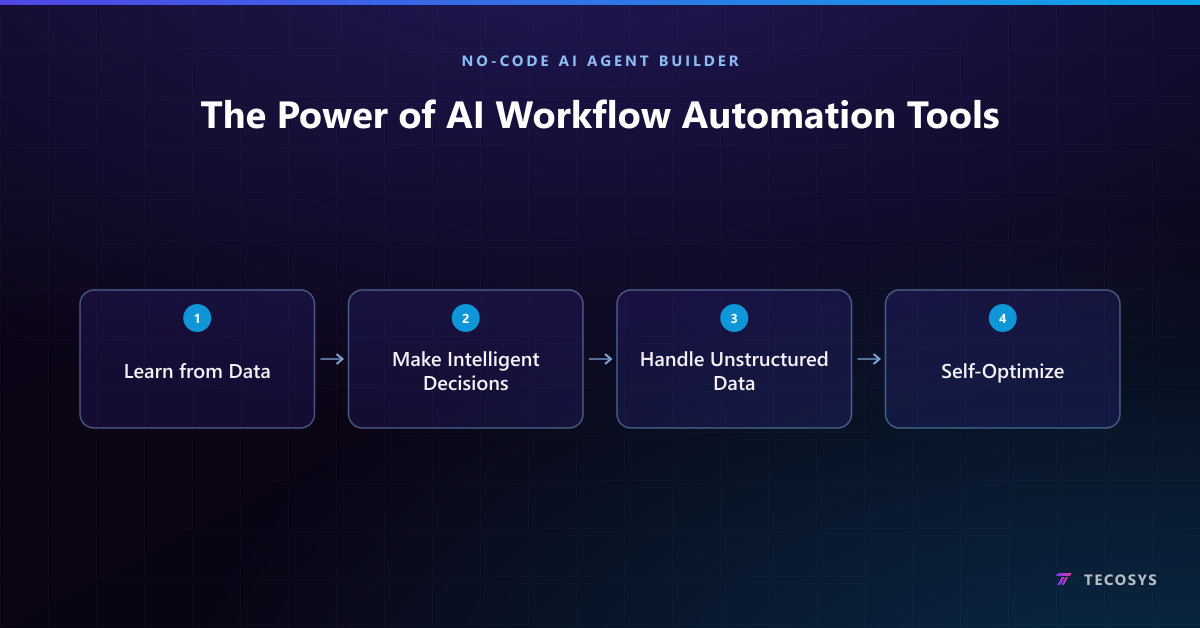
So, what is an agentic workflow? It’s an AI-driven process where autonomous AI agents orchestrate tasks, make decisions, and coordinate actions with minimal human intervention, striving to achieve a specific business objective. Unlike sequential, rule-based workflows, agentic workflows are dynamic and adaptive.
Here’s a breakdown of how agentic workflows operate:
Trigger Event: A real-world event or data input initiates the workflow (e.g., a customer inquiry, a new order, a sensor reading).
Perception and Interpretation: An AI agent receives the input and interprets its context, often using advanced NLP for text or speech, or computer vision for images.
Planning and Decision-Making: Based on its understanding and defined goals, the AI agent calculates a plan of action, selecting the most appropriate tools and steps. This might involve interacting with various internal systems or external APIs.
Execution: The agent executes the planned actions, which could range from sending an email, updating a database, generating a report, or initiating a robotic process.
Monitoring and Adaptation: The agent continuously monitors the results of its actions and the overall progress of the workflow. If unexpected outcomes occur or new information becomes available, the agent can adapt its plan and take corrective measures.
Human Escalation/Collaboration: For highly complex, sensitive, or novel situations, the agent can seamlessly escalate to a human agent, providing all necessary context and data to facilitate a swift resolution.
This iterative, intelligent loop makes agentic workflows incredibly powerful, leading to significant improvements in speed, accuracy, and scalability across numerous enterprise functions.
US enterprises are at the forefront of adopting autonomous AI, recognizing its potential to deliver a competitive edge. Here are some key sectors and their transformative applications:
One of the most immediate and impactful areas for AI agent deployment is customer service. AI agents for customer service are rapidly evolving beyond basic chatbots to become sophisticated virtual assistants, capable of handling a wide array of inquiries and even proactive engagement.
The financial sector, with its massive data volumes and stringent regulatory requirements, is a natural fit for autonomous AI.
Autonomous AI is set to revolutionize healthcare, from patient care to administrative tasks and drug discovery.
The complexities of modern supply chains make them ripe for AI agent intervention.
One of the most exciting developments in the autonomous AI space is the emergence of no-code AI agent builders. Traditionally, deploying sophisticated AI solutions required significant coding expertise and data science resources. No-code platforms democratize AI by enabling business users, analysts, and domain experts — not just developers — to create, configure, and deploy AI agents using intuitive visual interfaces, drag-and-drop functionalities, and pre-built templates.
The benefits of a no-code AI agent builder are immense for US enterprises:
These platforms often come with pre-built connectors to popular enterprise applications, allowing seamless integration and data flow, further simplifying the creation of powerful agentic workflows.
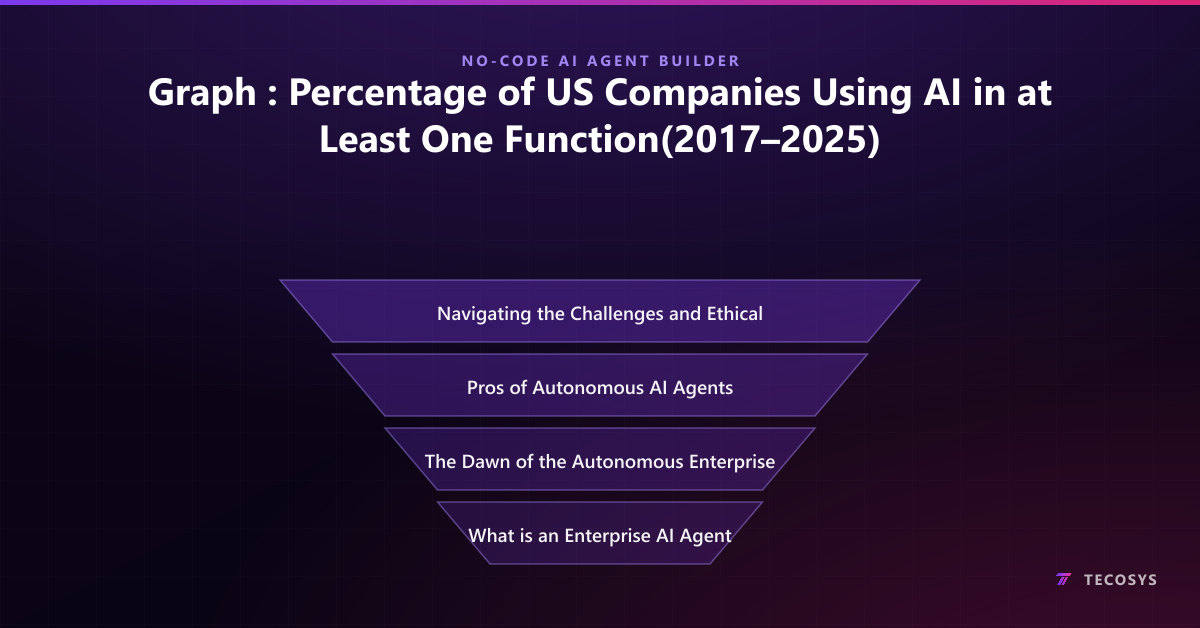
X-axis: Year
Y-axis: % of Companies Using AI
Year & % of companies using AI — [ 2017–20% ] [ 2018–47% ] [ 2019–58% ] [2020–50% ] [ 2021–56% ] [ 2022–50% ] [ 2023–55% ] [ 2024–72% ] [2025–78%]
While the promise of autonomous AI is undeniable, US enterprises must also navigate potential challenges and ethical considerations. Understanding both the advantages and disadvantages is crucial for responsible adoption.
The trajectory of autonomous AI in US enterprises points towards an even more integrated and intelligent future. We can anticipate:
The enterprise AI agent platform market will continue to mature, offering more specialized functionalities and industry-specific solutions. AI workflow automation tools will become even more sophisticated, capable of handling highly dynamic and complex processes.
Imagine having the power of artificial intelligence at your fingertips — without needing to code, hire expensive developers, or feel overwhelmed by tech jargon. That’s what Nutaan AI is all about.
It’s not just another AI platform. Nutaan is designed for real people — non-techies, professionals, business owners, and curious minds — who want to do more with less. Whether you’re in HR, marketing, operations, or running your own venture, Nutaan helps you turn your ideas into smart, automated solutions. No coding. No hassle. Just results.
Nutaan removes the technical barriers. You can build AI models, automate workflows, or generate predictions without hiring developers or learning programming.
2. Smart Business AutomationFrom customer service agents to data processing bots, Nutaan helps companies automate repetitive tasks, saving time and cutting operational costs.
3. Real-Time Decision MakingWith built-in data analysis and dashboard features, Nutaan AI provides actionable insights in seconds, helping teams make smarter, faster decisions.
4. Empowers HR, Marketing & OperationsHR: Automate resume screening, employee sentiment analysis, and onboarding workflows.
Marketing: Generate personalized content, predict campaign performance, and improve customer targeting.
Operations: Forecast demand, manage inventory, and optimize logistics.
5. Scalable for Startups to EnterprisesWhether you’re a small business or a large enterprise, Nutaan scales with your growth. Start with a simple automation and evolve into full AI-powered operations.
6. Privacy-First & SecureNutaan AI is built with compliance and data security in mind — ensuring your information is safe while you harness its power.
>Did you enjoy this article? Share it with someone building their brand!
Have questions or want a demo? click here.
The rise of autonomous AI, powered by advanced enterprise AI agent platforms and transformative AI workflow automation tools, marks a pivotal moment for US enterprises. From enhancing customer experiences with advanced AI agents for customer service to optimizing complex supply chains and financial operations, these intelligent agents are rewriting the rules of business efficiency and innovation.
The shift towards agentic workflows is not merely an incremental improvement; it’s a fundamental change in how work gets done, allowing businesses to operate with unprecedented speed, accuracy, and adaptability. While challenges related to data, ethics, and workforce transformation remain, the burgeoning ecosystem of no-code AI agent builders is making this powerful technology accessible to a broader range of organizations, accelerating its adoption and impact.
For US enterprises looking to thrive in the increasingly competitive global landscape, embracing autonomous AI is no longer an option but a strategic imperative. By intelligently deploying these powerful tools, businesses can unlock new levels of productivity, foster innovation, and ultimately, build a more resilient and future-proof enterprise.
🎯Are you ready to explore how autonomous AI agents can transform your enterprise operations?
💭Share your thoughts and questions below, or reach out to learn more about implementing cutting-edge AI solutions here.